MedForge: Interpretable Medical Deepfake Detection via Forgery-aware Reasoning
ACL 2026 Main Conference
Overview
Our paper has been accepted to the ACL 2026 Main Conference: MedForge: Interpretable Medical Deepfake Detection via Forgery-aware Reasoning.
As generative models become more powerful, medical deepfakes are becoming increasingly realistic: lesions can be injected into or removed from medical images while remaining visually plausible. This poses new risks to clinical safety, medical AI robustness, and the integrity of medical evidence. Existing methods mostly treat the task as binary real-vs-fake classification, but provide little insight into where the forgery is or why a sample is judged as manipulated.
To address this, we present MedForge, an interpretable framework for medical deepfake detection:
- MedForge-90K: the first large-scale explainable medical deepfake dataset covering CT, MRI, and X-ray, with 19 lesion types and forgeries generated by 10 state-of-the-art deepfake models.
- Each forged sample is annotated with expert-guided localization masks and clinical-grade explanations.
- MedForge-Reasoner: an interpretable detector built on a Localize-then-Analyze chain-of-thought reasoning paradigm, trained with a vision-language model and Forgery-aware GSPO reinforcement learning.
Experiments show that MedForge-Reasoner achieves state-of-the-art detection performance while producing professional, localized, and verifiable medical explanations. The model, dataset, and interactive demo are publicly available through Hugging Face.
Many thanks to the team and to Prof. Mengling Feng for the great support.
Figures
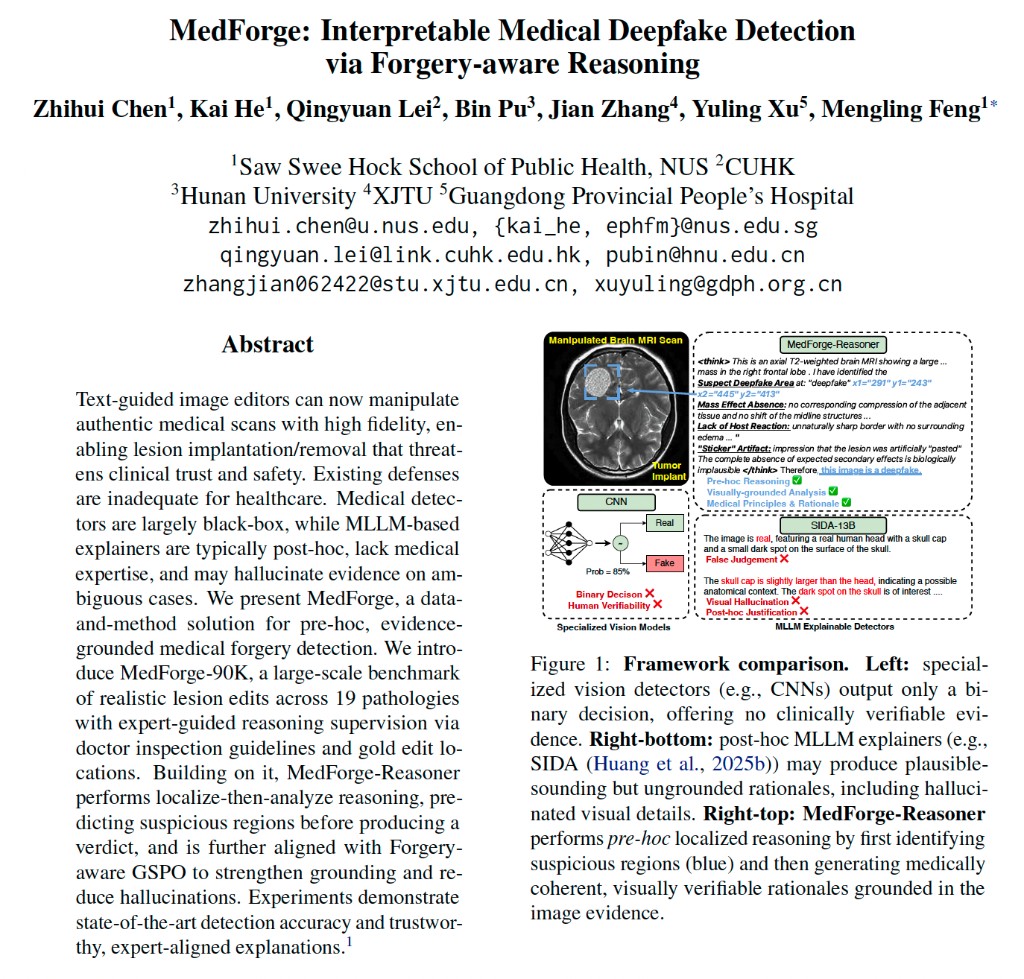
Figure 1 — Overview of MedForge and comparison to specialized detectors and generic MLLM baselines.
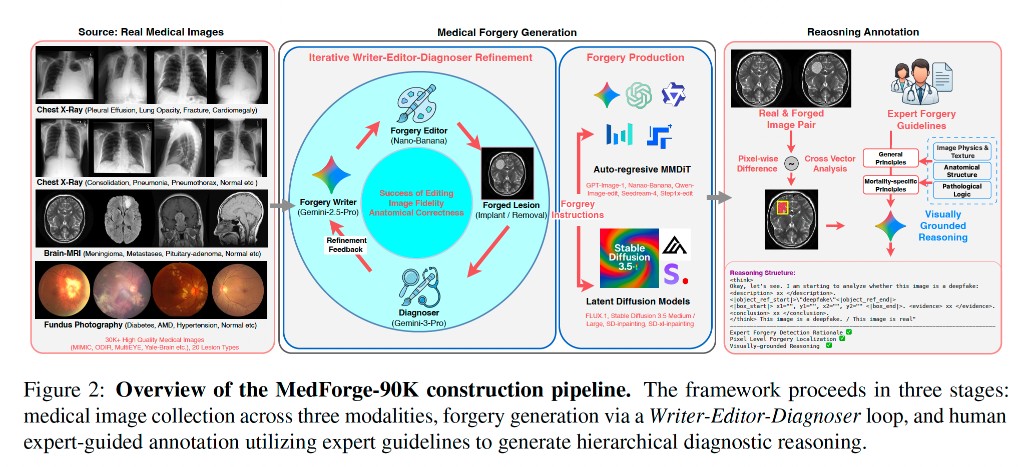
Figure 2 — MedForge-90K construction: real images, forgery generation, and reasoning annotation.
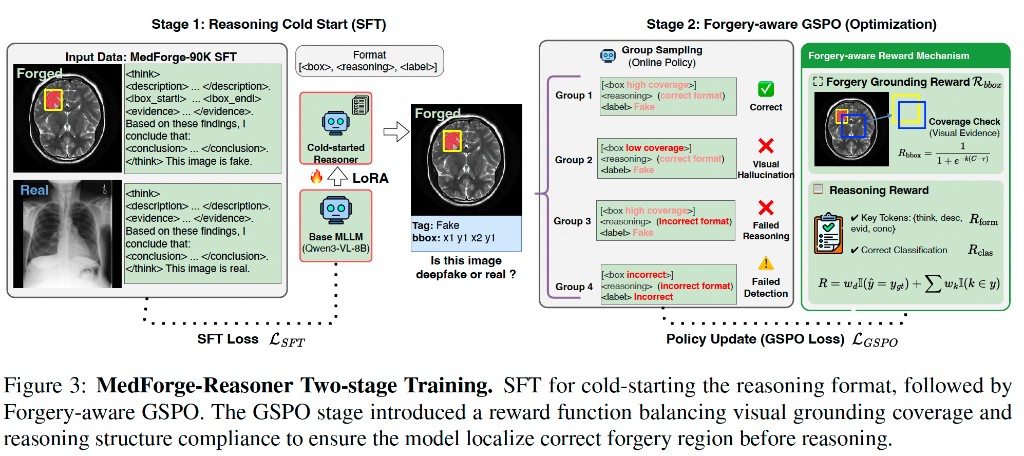
Figure 3 — MedForge-Reasoner two-stage training: reasoning cold-start (SFT) and Forgery-aware GSPO.
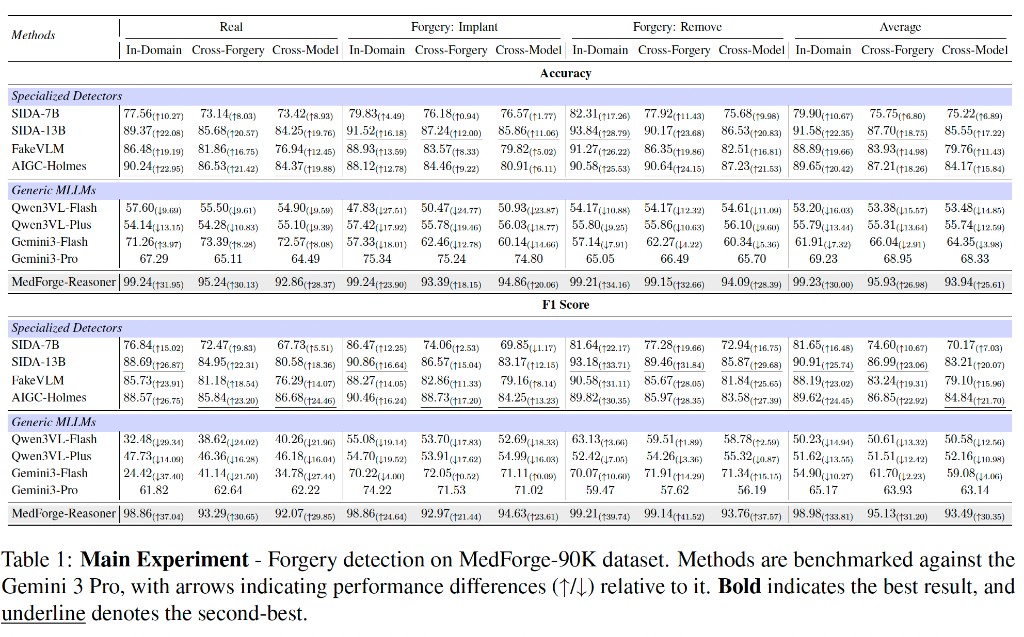
Figure 4 — Main results: forgery detection on the MedForge-90K benchmark.
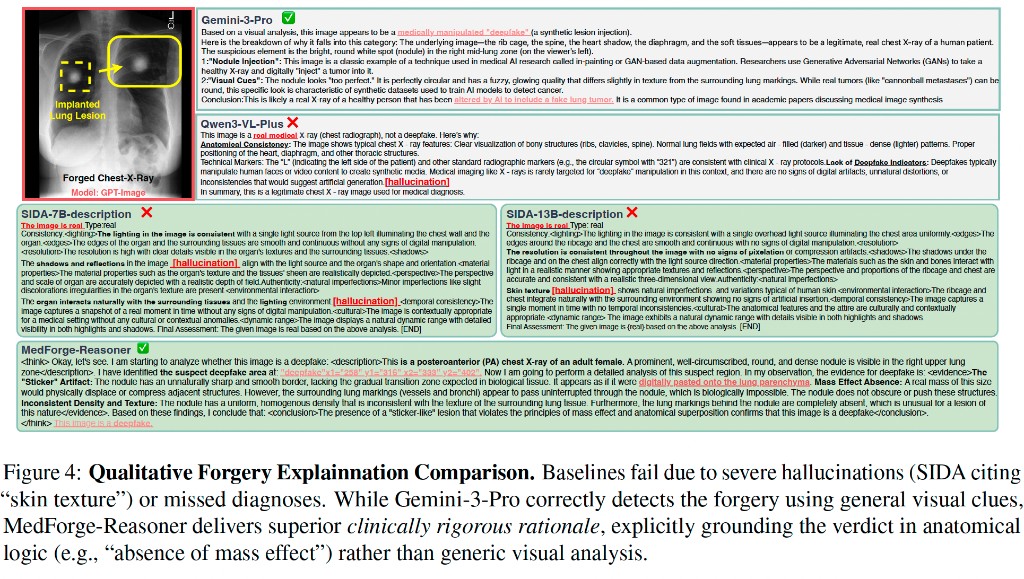
Figure 5 — Qualitative comparison of interpretable forgery judgments and rationales.